Sketches of Young Gentlemen, by Charles Dickens
Transcribed from the 1903 Chapman and coding robots for 4 year olds under 30 dollarsHall Sketches byBozedition by David Price, email [email protected]
SKETCHES OF YOUNG GENTLEMEN
p. 402TO THE YOUNG LADIES
OF THE
United Kingdom of Great Britain and Ireland;
ALSO
THE YOUNG LADIES
OF
THE PRINCIPALITY OFWALES,
AND LIKEWISE
THE YOUNG LADIES
RESIDENT IN THE ISLES OF
Guernsey, Jersey, Alderney, and Sark,
THE HUMBLE DEDICATION OF THEIR DEVOTEDADMIRER,
Sheweth,—
That your Dedicator has perused,with feelings of virtuous indignation, a work purporting to be‘Sketches of Young Ladies;’ written by Quiz,illustrated by Phiz, and published in one volume, squaretwelvemo.
That after an attentive andvigilant perusal of the said work, your Dedicator is humbly ofopinion that so many libels, upon your Honourable sex, were nevercontained in any previously published work, in twelvemo or anyother mo.
That in the title page and prefaceto the said work, your Honourable sex are described andclassified as animals; and although your Dedicator is not atpresent prepared to deny that you areanimals, still hehumbly submits that it is not polite to call you so.
That in the aforesaid preface, yourHonourable sex are also described as Troglodites, which, being ahard word, may, for aught your Honourable sex or your Dedicatorcan say to the contrary, be an injurious and disrespectfulappellation.
That the author of the said workapplied himself to his task in malice prepense and withwickedness aforethought; a fact which, your Dedicator contends,is sufficiently demonstrated, by his assuming the name of Quiz,which, your Dedicator submits, denotes a foregone conclusion, andimplies an intention of quizzing.
That in the execution of his evildesign, the said Quiz, or author of the said work, must havebetrayed some trust or confidence reposed in him by some membersof your Honourable sex, otherwise he never could have acquired somuch information relative to the manners and customs of yourHonourable sex in general.
That actuated by theseconsiderations, and further moved by various slanders andinsinuations respecting your Honourable sex contained in the saidwork, square twelvemo, entitled ‘Sketches of YoungLadies,’ your Dedicator ventures to produce another work,square twelvemo, entitled ‘Sketches of YoungGentlemen,’ of which he now solicits your acceptance andapproval.
That as the Young Ladies are thebest companions of the Young Gentlemen, so the Young Gentlemenshould be the best companions of the Young Ladies; and extendingthe comparison from animals (to quote the disrespectful languageof the said Quiz) to inanimate objects, your Dedicator humblysuggests, that such of your Honourable sex as purchased the baneshould possess themselves of the antidote, and that those of yourHonourable sex who were not rash enough to take the first, shouldlose no time in swallowing the last,—prevention being inall cases better than cure, as we are informed upon theauthority, not only of general acknowledgment, but also oftraditionary wisdom.
That with reference to the saidbane and antidote, your Dedicator has no further remarks to make,than are comprised in the printed directions issued with DoctorMorison’s pills; namely, that whenever your Honourable sextake twenty-five of Number, 1, you will be pleased to take fiftyof Number 2, without delay.
And your Dedicator shall ever pray,&c.
CONTENTS
| PAGE |
The Bashful Young Gentleman | 403 |
The Out-and-out Young Gentleman | 407 |
The Very Friendly Young Gentleman | 410 |
The Military Young Gentleman | 414 |
The Political Young Gentleman | 418 |
The Domestic Young Gentleman | 421 |
The Censorious Young Gentleman | 424 |
The Funny Young Gentleman | 427 |
The Theatrical Young Gentleman | 431 |
The Poetical Young Gentleman | 433 |
The ‘Throwing-off’ Young Gentleman | 436 |
The Young Ladies’ Young Gentleman | 439 |
Conclusion | 443 |
p. 403THEBASHFUL YOUNG GENTLEMAN
We found ourself seated at a smalldinner party the other day, opposite a stranger of such singularappearance and manner, that he irresistibly attracted ourattention.
This was a fresh-coloured young gentleman, with as good apromise of light whisker as one might wish to see, and possessedof a very velvet-like, soft-looking countenance. We do notuse the latter term invidiously, but merely to denote a pair ofsmooth, plump, highly-coloured cheeks of capacious dimensions,and a mouth rather remarkable for the fresh hue of the lips thanfor any marked or striking expression it presented. Hiswhole face was suffused with a crimson blush, and bore thatdowncast, timid, retiring look, which betokens a man ill at easewith himself.
There was nothing in these symptoms to attract more than apassing remark, but our attention had been originally drawn tothe bashful young gentleman, on his first appearance in thedrawing-room above-stairs, into which he was no soonerintroduced, than making his way towards us who were standing in awindow, and wholly neglecting several persons who warmly accostedhim, he seized our hand with visible emotion, and pressed it witha convulsive grasp for a good couple of minutes, after which hedived in a nervous manner across the room, oversetting in his waya fine little girl of six years and a quarter old—andshrouding himself behind some hangings, was seen no more, untilthe eagle eye of the hostess detecting him in his concealment, onthe announcement of dinner, he was requested to pair off with alively single lady, of two or three and thirty.
This most flattering salutation from a perfect stranger, wouldhave gratified us not a little as a token of his having held usin high respect, and for that reason been desirous of ouracquaintance, if we had not suspected from the first, that theyoung gentleman, in making a desperate effort to get through theceremony of introduction, had, in the bewilderment of his ideas,shaken hands with us at random. This impression was fullyconfirmed by the subsequent behaviour of the bashful younggentleman in question, which we noted particularly, with the viewof ascertaining whether we were right in our conjecture.
The young gentleman seated himself at table with evidentmisgivings, and turning sharp round to pay attention to someobservation of his loquacious neighbour, overset his bread. There was nothing very bad in this, and if he had had thepresence of mind to let it go, and say nothing about it, nobodybut the man who had laid the cloth would have been a bit thewiser; but the young gentleman in various semi-successfulattempts to prevent its fall, played with it a little, asgentlemen in the streets may be seen to do with their hats on awindy day, and then giving the roll a smart rap in his anxiety tocatch it, knocked it with great adroitness into a tureen of whitesoup at some distance, to the unspeakable terror and disturbanceof a very amiable bald gentleman, who was dispensing thecontents. We thought the bashful young gentleman would havegone off in an apoplectic fit, consequent upon the violent rushof blood to his face at the occurrence of this catastrophe.
From this moment we perceived, in the phraseology of thefancy, that it was ‘all up’ with the bashful younggentleman, and so indeed it was. Several benevolent personsendeavoured to relieve his embarrassment by taking wine with him,but finding that it only augmented his sufferings, and that aftermingling sherry, champagne, hock, and moselle together, heapplied the greater part of the mixture externally, instead ofinternally, they gradually dropped off, and left him to theexclusive care of the talkative lady, who, not noting thewildness of his eye, firmly believed she had secured alistener. He broke a glass or two in the course of themeal, and disappeared shortly afterwards; it is inferred that hewent away in some confusion, inasmuch as he left the house inanother gentleman’s coat, and the footman’s hat.
This little incident led us to reflect upon the most prominentcharacteristics of bashful young gentlemen in the abstract; andas this portable volume will be the great text-book of youngladies in all future generations, we record them here for theirguidance and behoof.
If the bashful young gentleman, in turning a street corner,chance to stumble suddenly upon two or three young ladies of hisacquaintance, nothing can exceed his confusion andagitation. His first impulse is to make a great variety ofbows, and dart past them, which he does until, observing thatthey wish to stop, but are uncertain whether to do so or not, hemakes several feints of returning, which causes them to do thesame; and at length, after a great quantity of unnecessarydodging and falling up against the other passengers, he returnsand shakes hands most affectionately with all of them, in doingwhich he knocks out of their grasp sundry little parcels, whichhe hastily picks up, and returns very muddy and disordered. The chances are that the bashful young gentleman then observes itis very fine weather, and being reminded that it has only justleft off raining for the first time these three days, he blushesvery much, and smiles as if he had said a very good thing. The young lady who was most anxious to speak, here inquires, withan air of great commiseration, how his dear sister Harriet isto-day; to which the young gentleman, without the slightestconsideration, replies with many thanks, that she is remarkablywell. ‘Well, Mr. Hopkins!’ cries the younglady, ‘why, we heard she was bled yesterday evening, andhave been perfectly miserable about her.’ ‘Oh,ah,’ says the young gentleman, ‘so she was. Oh,she’s very ill, very ill indeed.’ The younggentleman then shakes his head, and looks very desponding (he hasbeen smiling perpetually up to this time), and after a shortpause, gives his glove a great wrench at the wrist, and says,with a strong emphasis on the adjective, ‘Goodmorning, goodmorning.’ And making a greatnumber of bows in acknowledgment of several little messages tohis sister, walks backward a few paces, and comes with greatviolence against a lamp-post, knocking his hat off in thecontact, which in his mental confusion and bodily pain he isgoing to walk away without, until a great roar from a carterattracts his attention, when he picks it up, and tries to smilecheerfully to the young ladies, who are looking back, and who, hehas the satisfaction of seeing, are all laughing heartily.
At a quadrille party, the bashful young gentleman alwaysremains as near the entrance of the room as possible, from whichposition he smiles at the people he knows as they come in, andsometimes steps forward to shake hands with more intimatefriends: a process which on each repetition seems to turn him adeeper scarlet than before. He declines dancing the firstset or two, observing, in a faint voice, that he would ratherwait a little; but at length is absolutely compelled to allowhimself to be introduced to a partner, when he is led, in a greatheat and blushing furiously, across the room to a spot wherehalf-a-dozen unknown ladies are congregated together.
‘Miss Lambert, let me introduce Mr. Hopkins for the nextquadrille.’ Miss Lambert inclines her headgraciously. Mr. Hopkins bows, and his fair conductressdisappears, leaving Mr. Hopkins, as he too well knows, to makehimself agreeable. The young lady more than half expectsthat the bashful young gentleman will say something, and thebashful young gentleman feeling this, seriously thinks whether hehas got anything to say, which, upon mature reflection, he israther disposed to conclude he has not, since nothing occurs tohim. Meanwhile, the young lady, after several inspectionsof her bouquet, all made in the expectation that thebashful young gentleman is going to talk, whispers her mamma, whois sitting next her, which whisper the bashful young gentlemanimmediately suspects (and possibly with very good reason) must beabout him. In this comfortable condition he remainsuntil it is time to ‘stand up,’ when murmuring a‘Will you allow me?’ he gives the young lady his arm,and after inquiring where she will stand, and receiving a replythat she has no choice, conducts her to the remotest corner ofthe quadrille, and making one attempt at conversation, whichturns out a desperate failure, preserves a profound silence untilit is all over, when he walks her twice round the room, depositsher in her old seat, and retires in confusion.
A married bashful gentleman—for these bashful gentlemendo get married sometimes; how it is ever brought about, is amystery to us—a married bashful gentleman either causes hiswife to appear bold by contrast, or merges her proper importancein his own insignificance. Bashful young gentlemen shouldbe cured, or avoided. They are never hopeless, and neverwill be, while female beauty and attractions retain theirinfluence, as any young lady will find, who may think it worthwhile on this confident assurance to take a patient in hand.
p. 407THEOUT-AND-OUT YOUNG GENTLEMAN
Out-and-out young gentlemen may bedivided into two classes—those who have something to do,and those who have nothing. I shall commence with theformer, because that species come more frequently under thenotice of young ladies, whom it is our province to warn and toinstruct.
The out-and-out young gentleman is usually no great dresser,his instructions to his tailor being all comprehended in the onegeneral direction to ‘make that what’s-a-name aregular bang-up sort of thing.’ For some years past,the favourite costume of the out-and-out young gentleman has beena rough pilot coat, with two gilt hooks and eyes to the velvetcollar; buttons somewhat larger than crown-pieces; a black orfancy neckerchief, loosely tied; a wide-brimmed hat, with a lowcrown; tightish inexpressibles, and iron-shod boots. Out ofdoors he sometimes carries a large ash stick, but only on specialoccasions, for he prefers keeping his hands in his coatpockets. He smokes at all hours, of course, and swearsconsiderably.
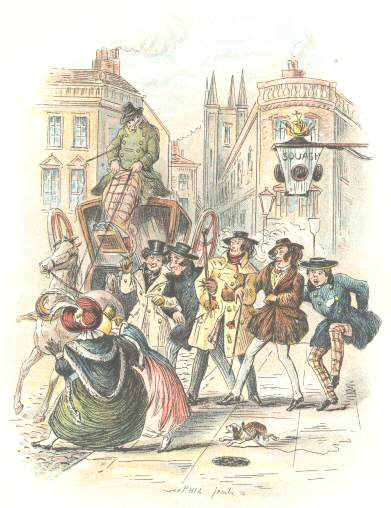
The out-and-out young gentleman is employed in a citycounting-house or solicitor’s office, in which he does aslittle as he possibly can: his chief places of resort are, thestreets, the taverns, and the theatres. In the streets atevening time, out-and-out young gentlemen have a pleasant customof walking six or eight abreast, thus driving females and otherinoffensive persons into the road, which never fails to affordthem the highest satisfaction, especially if there be anyimmediate danger of their being run over, which enhances the funof the thing materially. In all places of public resort,the out-and-outers are careful to select each a seat to himself,upon which he lies at full length, and (if the weather be verydirty, but not in any other case) he lies with his knees up, andthe soles of his boots planted firmly on the cushion, so that ifany low fellow should ask him to make room for a lady, he takesample revenge upon her dress, without going at all out of his wayto do it. He always sits with his hat on, and flourisheshis stick in the air while the play is proceeding, with adignified contempt of the performance; if it be possible for oneor two out-and-out young gentlemen to get up a little crowding inthe passages, they are quite in their element, squeezing,pushing, whooping, and shouting in the most humorous mannerpossible. If they can only succeed in irritating thegentleman who has a family of daughters under his charge, theyare like to die with laughing, and boast of it among theircompanions for a week afterwards, adding, that one or two of themwere ‘devilish fine girls,’ and that they reallythought the youngest would have fainted, which was the only thingwanted to render the joke complete.
If the out-and-out young gentleman have a mother and sisters,of course he treats them with becoming contempt, inasmuch as they(poor things!) having no notion of life or gaiety, are far tooweak-spirited and moping for him. Sometimes, however, on abirth-day or at Christmas-time, he cannot very well helpaccompanying them to a party at some old friend’s, withwhich view he comes home when they have been dressed an hour ortwo, smelling very strongly of tobacco and spirits, and afterexchanging his rough coat for some more suitable attire (in whichhowever he loses nothing of the out-and-outer), gets into thecoach and grumbles all the way at his own good nature: his bitterreflections aggravated by the recollection, that Tom Smith hastaken the chair at a little impromptu dinner at a fightingman’s, and that a set-to was to take place on adining-table, between the fighting man and his brother-in-law,which is probably ‘coming off’ at that veryinstant.
As the out-and-out young gentleman is by no means at his easein ladies’ society, he shrinks into a corner of thedrawing-room when they reach the friend’s, and unless oneof his sisters is kind enough to talk to him, remains therewithout being much troubled by the attentions of other people,until he espies, lingering outside the door, another gentleman,whom he at once knows, by his air and manner (for there is a kindof free-masonry in the craft), to be a brother out-and-outer, andtowards whom he accordingly makes his way. Conversationbeing soon opened by some casual remark, the second out-and-outerconfidentially informs the first, that he is one of the roughsort and hates that kind of thing, only he couldn’t verywell be off coming; to which the other replies, that that’sjust his case—‘and I’ll tell you what,’continues the out-and-outer in a whisper, ‘I should like aglass of warm brandy and water just now,’—‘Or apint of stout and a pipe,’ suggests the otherout-and-outer.
The discovery is at once made that they are sympathetic souls;each of them says at the same moment, that he sees the otherunderstands what’s what: and they become fast friends atonce, more especially when it appears, that the secondout-and-outer is no other than a gentleman, long favourably knownto his familiars as ‘Mr. Warmint Blake,’ who upondivers occasions has distinguished himself in a manner that wouldnot have disgraced the fighting man, and who—having been apretty long time about town—had the honour of once shakinghands with the celebrated Mr. Thurtell himself.
At supper, these gentlemen greatly distinguish themselves,brightening up very much when the ladies leave the table, andproclaiming aloud their intention of beginning to spend theevening—a process which is generally understood to besatisfactorily performed, when a great deal of wine is drunk anda great deal of noise made, both of which feats the out-and-outyoung gentlemen execute to perfection. Having protractedtheir sitting until long after the host and the other guests haveadjourned to the drawing-room, and finding that they have drainedthe decanters empty, they follow them thither with complexionsrather heightened, and faces rather bloated with wine; and theagitated lady of the house whispers her friends as they waltztogether, to the great terror of the whole room, that ‘bothMr. Blake and Mr. Dummins are very nice sort of young men intheir way, only they are eccentric persons, and unfortunatelyrather too wild!’
The remaining class of out-and-out young gentlemen is composedof persons, who, having no money of their own and a soul aboveearning any, enjoy similar pleasures, nobody knows how. These respectable gentlemen, without aiming quite so much at theout-and-out in external appearance, are distinguished by all thesame amiable and attractive characteristics, in an equal orperhaps greater degree, and now and then find their way intosociety, through the medium of the other class of out-and-outyoung gentlemen, who will sometimes carry them home, and whousually pay their tavern bills. As they are equallygentlemanly, clever, witty, intelligent, wise, and well-bred, weneed scarcely have recommended them to the peculiar considerationof the young ladies, if it were not that some of the gentlecreatures whom we hold in such high respect, are perhaps a littletoo apt to confound a great many heavier terms with the lightword eccentricity, which we beg them henceforth to take in astrictly Johnsonian sense, without any liberality or latitude ofconstruction.
p. 410THEVERY FRIENDLY YOUNG GENTLEMAN
We know—and all peopleknow—so many specimens of this class, that in selecting thefew heads our limits enable us to take from a great number, wehave been induced to give the very friendly young gentleman thepreference over many others, to whose claims upon a more cursoryview of the question we had felt disposed to assign thepriority.
The very friendly young gentleman is very friendly toeverybody, but he attaches himself particularly to two, or atmost to three families: regulating his choice by their dinners,their circle of acquaintance, or some other criterion in which hehas an immediate interest. He is of any age between twentyand forty, unmarried of course, must be fond of children, and isexpected to make himself generally useful if possible. Letus illustrate our meaning by an example, which is the shortestmode and the clearest.
We encountered one day, by chance, an old friend of whom wehad lost sight for some years, and who—expressing a stronganxiety to renew our former intimacy—urged us to dine withhim on an early day, that we might talk over old times. Wereadily assented, adding, that we hoped we should be alone. ‘Oh, certainly, certainly,’ said our friend,‘not a soul with us but Mincin.’ ‘And whois Mincin?’ was our natural inquiry. ‘Odon’t mind him,’ replied our friend,‘he’s a most particular friend of mine, and a veryfriendly fellow you will find him;’ and so he left us.
‘We thought no more about Mincin until we duly presentedourselves at the house next day, when, after a hearty welcome,our friend motioned towards a gentleman who had been previouslyshowing his teeth by the fireplace, and gave us to understandthat it was Mr. Mincin, of whom he had spoken. It requiredno great penetration on our part to discover at once that Mr.Mincin was in every respect a very friendly young gentleman.
‘I am delighted,’ said Mincin, hastily advancing,and pressing our hand warmly between both of his, ‘I amdelighted, I am sure, to make your acquaintance—(here hesmiled)—very much delighted indeed—(here he exhibiteda little emotion)—I assure you that I have looked forwardto it anxiously for a very long time:’ here he released ourhands, and rubbing his own, observed, that the day was severe,but that he was delighted to perceive from our appearance that itagreed with us wonderfully; and then went on to observe, that,notwithstanding the coldness of the weather, he had that morningseen in the paper an exceedingly curious paragraph, to theeffect, that there was now in the garden of Mr. Wilkins ofChichester, a pumpkin, measuring four feet in height, and elevenfeet seven inches in circumference, which he looked upon as avery extraordinary piece of intelligence. We ventured toremark, that we had a dim recollection of having once or twicebefore observed a similar paragraph in the public prints, uponwhich Mr. Mincin took us confidentially by the button, and said,Exactly, exactly, to be sure, we were very right, and he wonderedwhat the editors meant by putting in such things. Who thedeuce, he should like to know, did they suppose cared about them?that struck him as being the best of it.
The lady of the house appeared shortly afterwards, and Mr.Mincin’s friendliness, as will readily be supposed,suffered no diminution in consequence; he exerted much strengthand skill in wheeling a large easy-chair up to the fire, and thelady being seated in it, carefully closed the door, stirred thefire, and looked to the windows to see that they admitted no air;having satisfied himself upon all these points, he expressedhimself quite easy in his mind, and begged to know how she foundherself to-day. Upon the lady’s replying very well,Mr. Mincin (who it appeared was a medical gentleman) offered somegeneral remarks upon the nature and treatment of colds in thehead, which occupied us agreeably until dinner-time. Duringthe meal, he devoted himself to complimenting everybody, notforgetting himself, so that we were an uncommonly agreeablequartette.
‘I’ll tell you what, Capper,’ said Mr.Mincin to our host, as he closed the room door after the lady hadretired, ‘you have very great reason to be fond of yourwife. Sweet woman, Mrs. Capper, sir!’ ‘Nay, Mincin—I beg,’ interposed the host, as wewere about to reply that Mrs. Capper unquestionably wasparticularly sweet. ‘Pray, Mincin,don’t.’ ‘Why not?’ exclaimed Mr.Mincin, ‘why not? Why should you feel any delicacybefore your old friend—ourold friend, if I may beallowed to call you so, sir; why should you, I ask?’ We of course wished to know why he should also, upon which ourfriend admitted that Mrs. Capper wasa very sweet woman,at which admission Mr. Mincin cried ‘Bravo!’ andbegged to propose Mrs. Capper with heartfelt enthusiasm,whereupon our host said, ‘Thank you, Mincin,’ withdeep feeling; and gave us, in a low voice, to understand, thatMincin had saved Mrs. Capper’s cousin’s life no lessthan fourteen times in a year and a half, which he considered nocommon circumstance—an opinion to which we most cordiallysubscribed.
Now that we three were left to entertain ourselves withconversation, Mr. Mincin’s extreme friendliness becameevery moment more apparent; he was so amazingly friendly, indeed,that it was impossible to talk about anything in which he had notthe chief concern. We happened to allude to some affairs inwhich our friend and we had been mutually engaged nearly fourteenyears before, when Mr. Mincin was all at once reminded of a jokewhich our friend had made on that day four years, which hepositively must insist upon telling—and which he did tellaccordingly, with many pleasant recollections of what he said,and what Mrs. Capper said, and how he well remembered that theyhad been to the play with orders on the very night previous, andhad seen Romeo and Juliet, and the pantomime, and how Mrs. Capperbeing faint had been led into the lobby, where she smiled, saidit was nothing after all, and went back again, with many otherinteresting and absorbing particulars: after which the friendlyyoung gentleman went on to assure us, that our friend hadexperienced a marvellously prophetic opinion of that samepantomime, which was of such an admirable kind, that two morningpapers took the same view next day: to this our friend replied,with a little triumph, that in that instance he had some reasonto think he had been correct, which gave the friendly younggentleman occasion to believe that our friend was always correct;and so we went on, until our friend, filling a bumper, said hemust drink one glass to his dear friend Mincin, than whom hewould say no man saved the lives of his acquaintances more, orhad a more friendly heart. Finally, our friend havingemptied his glass, said, ‘God bless you,Mincin,’—and Mr. Mincin and he shook hands across thetable with much affection and earnestness.
But great as the friendly young gentleman is, in a limitedscene like this, he plays the same part on a larger scale withincreased éclat. Mr. Mincin is invited to anevening party with his dear friends the Martins, where he meetshis dear friends the Cappers, and his dear friends the Watsons,and a hundred other dear friends too numerous to mention. He is as much at home with the Martins as with the Cappers; buthow exquisitely he balances his attentions, and divides themamong his dear friends! If he flirts with one of the MissWatsons, he has one little Martin on the sofa pulling his hair,and the other little Martin on the carpet riding on hisfoot. He carries Mrs. Watson down to supper on one arm, andMiss Martin on the other, and takes wine so judiciously, and insuch exact order, that it is impossible for the most punctiliousold lady to consider herself neglected. If any young lady,being prevailed upon to sing, become nervous afterwards, Mr.Mincin leads her tenderly into the next room, and restores herwith port wine, which she must take medicinally. If anygentleman be standing by the piano during the progress of theballad, Mr. Mincin seizes him by the arm at one point of themelody, and softly beating time the while with his head,expresses in dumb show his intense perception of the delicacy ofthe passage. If anybody’s self-love is to beflattered, Mr. Mincin is at hand. If anybody’soverweening vanity is to be pampered, Mr. Mincin will surfeitit. What wonder that people of all stations and agesrecognise Mr. Mincin’s friendliness; that he is universallyallowed to be handsome as amiable; that mothers think him anoracle, daughters a dear, brothers a beau, and fathers awonder! And who would not have the reputation of the veryfriendly young gentleman?
p. 414THEMILITARY YOUNG GENTLEMAN
We are rather at a loss to imaginehow it has come to pass that military young gentlemen haveobtained so much favour in the eyes of the young ladies of thiskingdom. We cannot think so lightly of them as to supposethat the mere circumstance of a man’s wearing a red coatensures him a ready passport to their regard; and even if thiswere the case, it would be no satisfactory explanation of thecircumstance, because, although the analogy may in some degreehold good in the case of mail coachmen and guards, still generalpostmen wear red coats, and theyare not to our knowledgebetter received than other men; nor are firemen either, who wear(or used to wear) not only red coats, but very resplendent andmassive badges besides—much larger than epaulettes. Neither do the twopenny post-office boys, if the result of ourinquiries be correct, find any peculiar favour in woman’seyes, although they wear very bright red jackets, and have theadditional advantage of constantly appearing in public onhorseback, which last circumstance may be naturally supposed tobe greatly in their favour.
We have sometimes thought that this phenomenon may take itsrise in the conventional behaviour of captains and colonels andother gentlemen in red coats on the stage, where they areinvariably represented as fine swaggering fellows, talking ofnothing but charming girls, their king and country, their honour,and their debts, and crowing over the inferior classes of thecommunity, whom they occasionally treat with a little gentlemanlyswindling, no less to the improvement and pleasure of theaudience, than to the satisfaction and approval of the choicespirits who consort with them. But we will not devote thesepages to our speculations upon the subject, inasmuch as ourbusiness at the present moment is not so much with the youngladies who are bewitched by her Majesty’s livery as withthe young gentlemen whose heads are turned by it. For‘heads’ we had written ‘brains;’ but uponconsideration, we think the former the more appropriate word ofthe two.
These young gentlemen may be divided into twoclasses—young gentlemen who are actually in the army, andyoung gentlemen who, having an intense and enthusiasticadmiration for all things appertaining to a military life, arecompelled by adverse fortune or adverse relations to wear outtheir existence in some ignoble counting-house. We willtake this latter description of military young gentlemenfirst.
The whole heart and soul of the military young gentleman areconcentrated in his favourite topic. There is nothing thathe is so learned upon as uniforms; he will tell you, withoutfaltering for an instant, what the habiliments of any oneregiment are turned up with, what regiment wear stripes down theoutside and inside of the leg, and how many buttons the Tenth hadon their coats; he knows to a fraction how many yards and oddinches of gold lace it takes to make an ensign in the Guards; isdeeply read in the comparative merits of different bands, and theapparelling of trumpeters; and is very luminous indeed indescanting upon ‘crack regiments,’ and the‘crack’ gentlemen who compose them, of whosemightiness and grandeur he is never tired of telling.
We were suggesting to a military young gentleman only theother day, after he had related to us several dazzling instancesof the profusion of half-a-dozen honourable ensign somebodies ornobodies in the articles of kid gloves and polished boots, thatpossibly ‘cracked’ regiments would be an improvementupon ‘crack,’ as being a more expressive andappropriate designation, when he suddenly interrupted us bypulling out his watch, and observing that he must hurry off tothe Park in a cab, or he would be too late to hear the bandplay. Not wishing to interfere with so important anengagement, and being in fact already slightly overwhelmed by theanecdotes of the honourable ensigns afore-mentioned, we made noattempt to detain the military young gentleman, but partedcompany with ready good-will.
Some three or four hours afterwards, we chanced to be walkingdown Whitehall, on the Admiralty side of the way, when, as wedrew near to one of the little stone places in which a couple ofhorse soldiers mount guard in the daytime, we were attracted bythe motionless appearance and eager gaze of a young gentleman,who was devouring both man and horse with his eyes, so eagerly,that he seemed deaf and blind to all that was passing aroundhim. We were not much surprised at the discovery that itwas our friend, the military young gentleman, but we werea little astonished when we returned from a walk to South Lambethto find him still there, looking on with the same intensity asbefore. As it was a very windy day, we felt bound to awakenthe young gentleman from his reverie, when he inquired of us withgreat enthusiasm, whether ‘that was not a gloriousspectacle,’ and proceeded to give us a detailed account ofthe weight of every article of the spectacle’s trappings,from the man’s gloves to the horse’s shoes.
We have made it a practice since, to take the Horse Guards inour daily walk, and we find it is the custom of military younggentlemen to plant themselves opposite the sentries, andcontemplate them at leisure, in periods varying from fifteenminutes to fifty, and averaging twenty-five. We were muchstruck a day or two since, by the behaviour of a very promisingyoung butcher who (evincing an interest in the service, whichcannot be too strongly commanded or encouraged), after aprolonged inspection of the sentry, proceeded to handle his bootswith great curiosity, and as much composure and indifference asif the man were wax-work.
But the really military young gentleman is waiting all thistime, and at the very moment that an apology rises to our lips,he emerges from the barrack gate (he is quartered in a garrisontown), and takes the way towards the high street. He wearshis undress uniform, which somewhat mars the glory of his outwardman; but still how great, how grand, he is! What a happymixture of ease and ferocity in his gait and carriage, and howlightly he carries that dreadful sword under his arm, making nomore ado about it than if it were a silk umbrella! The lionis sleeping: only think if an enemy were in sight, how soonhe’d whip it out of the scabbard, and what a terriblefellow he would be!
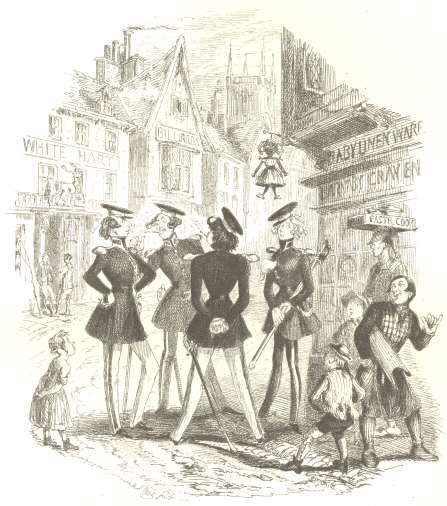
But he walks on, thinking of nothing less than blood andslaughter; and now he comes in sight of three other militaryyoung gentlemen, arm-in-arm, who are bearing down towards him,clanking their iron heels on the pavement, and clashing theirswords with a noise, which should cause all peaceful men to quailat heart. They stop to talk. See how theflaxen-haired young gentleman with the weak legs—he who hashis pocket-handkerchief thrust into the breast of his coat-glaresupon the fainthearted civilians who linger to look upon hisglory; how the next young gentleman elevates his head in the air,and majestically places his arms a-kimbo, while the third standswith his legs very wide apart, and clasps his hands behindhim. Well may we inquire—not in familiar jest, but inrespectful earnest—if you call that nothing. Oh! ifsome encroaching foreign power—the Emperor of Russia, forinstance, or any of those deep fellows, could only see thosemilitary young gentlemen as they move on together towards thebilliard-room over the way, wouldn’t he tremble alittle!
And then, at the Theatre at night, when the performances areby command of Colonel Fitz-Sordust and the officers of thegarrison—what a splendid sight it is! How sternly thedefenders of their country look round the house as if in muteassurance to the audience, that they may make themselvescomfortable regarding any foreign invasion, for they (themilitary young gentlemen) are keeping a sharp look-out, and areready for anything. And what a contrast between them, andthat stage-box full of grey-headed officers with tokens of manybattles about them, who have nothing at all in common with themilitary young gentlemen, and who—but for an old-fashionedkind of manly dignity in their looks and bearing—might becommon hard-working soldiers for anything they take the pains toannounce to the contrary!
Ah! here is a family just come in who recognise theflaxen-headed young gentleman; and the flaxen-headed younggentleman recognises them too, only he doesn’t care to showit just now. Very well done indeed! He talks louderto the little group of military young gentlemen who are standingby him, and coughs to induce some ladies in the next box but oneto look round, in order that their faces may undergo the sameordeal of criticism to which they have subjected, in not a whollyinaudible tone, the majority of the female portion of theaudience. Oh! a gentleman in the same box looks round as ifhe were disposed to resent this as an impertinence; and theflaxen-headed young gentleman sees his friends at once, andhurries away to them with the most charming cordiality.
Three young ladies, one young man, and the mamma of the party,receive the military young gentleman with great warmth andpoliteness, and in five minutes afterwards the military younggentleman, stimulated by the mamma, introduces the two othermilitary young gentlemen with whom he was walking in the morning,who take their seats behind the young ladies and commenceconversation; whereat the mamma bestows a triumphant bow upon arival mamma, who has not succeeded in decoying any military younggentlemen, and prepares to consider her visitors from that momentthree of the most elegant and superior young gentlemen in thewhole world.
p. 418THEPOLITICAL YOUNG GENTLEMAN
Once upon a time—notin the days when pigs drank wine, but in a more recent period ofour history—it was customary to banish politics when ladieswere present. If this usage still prevailed, we should havehad no chapter for political young gentlemen, for ladies wouldhave neither known nor cared what kind of monster a politicalyoung gentleman was. But as this good custom in common withmany others has ‘gone out,’ and left no word when itis likely to be home again; as political young ladies are by nomeans rare, and political young gentlemen the very reverse ofscarce, we are bound in the strict discharge of our mostresponsible duty not to neglect this natural division of oursubject.
If the political young gentleman be resident in a country town(and there arepolitical young gentlemen in country townssometimes), he is wholly absorbed in his politics; as a pair ofpurple spectacles communicate the same uniform tint to allobjects near and remote, so the political glasses, with which theyoung gentleman assists his mental vision, give to everything thehue and tinge of party feeling. The political younggentleman would as soon think of being struck with the beauty ofa young lady in the opposite interest, as he would dream ofmarrying his sister to the opposite member.
If the political young gentleman be a Conservative, he hasusually some vague ideas about Ireland and the Pope which hecannot very clearly explain, but which he knows are the rightsort of thing, and not to be very easily got over by the otherside. He has also some choice sentences regarding churchand state, culled from the banners in use at the last election,with which he intersperses his conversation at intervals withsurprising effect. But his great topic is the constitution,upon which he will declaim, by the hour together, with much heatand fury; not that he has any particular information on thesubject, but because he knows that the constitution is somehowchurch and state, and church and state somehow the constitution,and that the fellows on the other side say it isn’t, whichis quite a sufficient reason for him to say it is, and to stickto it.
Perhaps his greatest topic of all, though, is thepeople. If a fight takes place in a populous town, in whichmany noses are broken, and a few windows, the young gentlemanthrows down the newspaper with a triumphant air, and exclaims,‘Here’s your precious people!’ Ifhalf-a-dozen boys run across the course at race time, when itought to be kept clear, the young gentleman looks indignantlyround, and begs you to observe the conduct of the people; if thegallery demand a hornpipe between the play and the afterpiece,the same young gentleman cries ‘No’ and‘Shame’ till he is hoarse, and then inquires with asneer what you think of popular moderation now; in short,the people form a never-failing theme for him; and when theattorney, on the side of his candidate, dwells upon it with greatpower of eloquence at election time, as he never fails to do, theyoung gentleman and his friends, and the body they head, cheerwith great violence against the other people, with whom,of course, they have no possible connexion. In much thesame manner the audience at a theatre never fail to be highlyamused with any jokes at the expense of the public—alwayslaughing heartily at some other public, and never atthemselves.
If the political young gentleman be a Radical, he is usually avery profound person indeed, having great store of theoreticalquestions to put to you, with an infinite variety of possiblecases and logical deductions therefrom. If he be of theutilitarian school, too, which is more than probable, he isparticularly pleasant company, having many ingenious remarks tooffer upon the voluntary principle and various cheerfuldisquisitions connected with the population of the country, theposition of Great Britain in the scale of nations, and thebalance of power. Then he is exceedingly well versed in alldoctrines of political economy as laid down in the newspapers,and knows a great many parliamentary speeches by heart; nay, hehas a small stock of aphorisms, none of them exceeding a coupleof lines in length, which will settle the toughest question andleave you nothing to say. He gives all the young ladies tounderstand, that Miss Martineau is the greatest woman that everlived; and when they praise the good looks of Mr. Hawkins the newmember, says he’s very well for a representative, allthings considered, but he wants a little calling to account, andhe is more than half afraid it will be necessary to bring himdown on his knees for that vote on the miscellaneousestimates. At this, the young ladies express muchwonderment, and say surely a Member of Parliament is not to bebrought upon his knees so easily; in reply to which the politicalyoung gentleman smiles sternly, and throws out dark hintsregarding the speedy arrival of that day, when Members ofParliament will be paid salaries, and required to render weeklyaccounts of their proceedings, at which the young ladies uttermany expressions of astonishment and incredulity, while theirlady-mothers regard the prophecy as little else thanblasphemous.
It is extremely improving and interesting to hear twopolitical young gentlemen, of diverse opinions, discuss somegreat question across a dinner-table; such as, whether, if thepublic were admitted to Westminster Abbey for nothing, they wouldor would not convey small chisels and hammers in their pockets,and immediately set about chipping all the noses off the statues;or whether, if they once got into the Tower for a shilling, theywould not insist upon trying the crown on their own heads, andloading and firing off all the small arms in the armoury, to thegreat discomposure of Whitechapel and the Minories. Uponthese, and many other momentous questions which agitate thepublic mind in these desperate days, they will discourse withgreat vehemence and irritation for a considerable time together,both leaving off precisely where they began, and each thoroughlypersuaded that he has got the better of the other.
In society, at assemblies, balls, and playhouses, thesepolitical young gentlemen are perpetually on the watch for apolitical allusion, or anything which can be tortured orconstrued into being one; when, thrusting themselves into thevery smallest openings for their favourite discourse, they fallupon the unhappy company tooth and nail. They have recentlyhad many favourable opportunities of opening in churches, but asthere the clergyman has it all his own way, and must not becontradicted, whatever politics he preaches, they are fain tohold their tongues until they reach the outer door, though at theimminent risk of bursting in the effort.
As such discussions can please nobody but the talkativeparties concerned, we hope they will henceforth take the hint anddiscontinue them, otherwise we now give them warning, that theladies have our advice to discountenance such talkersaltogether.
p. 421THEDOMESTIC YOUNG GENTLEMAN
Let us make a slight sketch of ouramiable friend, Mr. Felix Nixon. We are strongly disposedto think, that if we put him in this place, he will answer ourpurpose without another word of comment.
Felix, then, is a young gentleman who lives at home with hismother, just within the twopenny-post office circle of threemiles from St. Martin-le-Grand. He wears Indiarubbergoloshes when the weather is at all damp, and always has a silkhandkerchief neatly folded up in the right-hand pocket of hisgreat-coat, to tie over his mouth when he goes home at night;moreover, being rather near-sighted, he carries spectacles forparticular occasions, and has a weakish tremulous voice, of whichhe makes great use, for he talks as much as any old ladybreathing.
The two chief subjects of Felix’s discourse, are himselfand his mother, both of whom would appear to be very wonderfuland interesting persons. As Felix and his mother are seldomapart in body, so Felix and his mother are scarcely ever separatein spirit. If you ask Felix how he finds himself to-day, heprefaces his reply with a long and minute bulletin of hismother’s state of health; and the good lady in her turn,edifies her acquaintance with a circumstantial and alarmingaccount, how he sneezed four times and coughed once after beingout in the rain the other night, but having his feet promptly putinto hot water, and his head into a flannel-something, which wewill not describe more particularly than by this delicateallusion, was happily brought round by the next morning, andenabled to go to business as usual.
Our friend is not a very adventurous or hot-headed person, buthe has passed through many dangers, as his mother can testify:there is one great story in particular, concerning a hackneycoachman who wanted to overcharge him one night for bringing themhome from the play, upon which Felix gave the aforesaid coachmana look which his mother thought would have crushed him to theearth, but which did not crush him quite, for he continued todemand another sixpence, notwithstanding that Felix took out hispocket-book, and, with the aid of a flat candle, pointed out thefare in print, which the coachman obstinately disregarding, heshut the street-door with a slam which his mother shudders tothink of; and then, roused to the most appalling pitch of passionby the coachman knocking a double knock to show that he was by nomeans convinced, he broke with uncontrollable force from hisparent and the servant girl, and running into the street withouthis hat, actually shook his fist at the coachman, and came backagain with a face as white, Mrs. Nixon says, looking about herfor a simile, as white as that ceiling. She never willforget his fury that night, Never!
To this account Felix listens with a solemn face, occasionallylooking at you to see how it affects you, and when his mother hasmade an end of it, adds that he looked at every coachman he metfor three weeks afterwards, in hopes that he might see thescoundrel; whereupon Mrs. Nixon, with an exclamation of terror,requests to know what he would have done to him if he hadseen him, at which Felix smiling darkly and clenching his rightfist, she exclaims, ‘Goodness gracious!’ with adistracted air, and insists upon extorting a promise that henever will on any account do anything so rash, which her dutifulson—it being something more than three years since theoffence was committed—reluctantly concedes, and his mother,shaking her head prophetically, fears with a sigh that his spiritwill lead him into something violent yet. The discoursethen, by an easy transition, turns upon the spirit which glowswithin the bosom of Felix, upon which point Felix himself becomeseloquent, and relates a thrilling anecdote of the time when heused to sit up till two o’clock in the morning readingFrench, and how his mother used to say, ‘Felix, you willmake yourself ill, I know you will;’ and how heusedto say, ‘Mother, I don’t care—I will doit;’ and how at last his mother privately procured a doctorto come and see him, who declared, the moment he felt his pulse,that if he had gone on reading one night more—only onenight more—he must have put a blister on each temple, andanother between his shoulders; and who, as it was, sat down uponthe instant, and writing a prescription for a blue pill, said itmust be taken immediately, or he wouldn’t answer for theconsequences. The recital of these and many other movingperils of the like nature, constantly harrows up the feelings ofMr. Nixon’s friends.
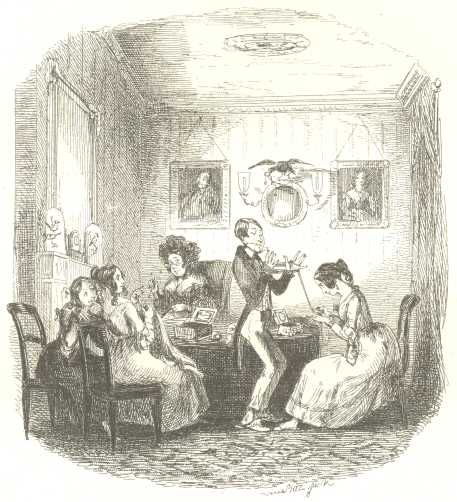
Mrs. Nixon has a tolerably extensive circle of femaleacquaintance, being a good-humoured, talkative, bustling littlebody, and to the unmarried girls among them she is constantlyvaunting the virtues of her son, hinting that she will be a veryhappy person who wins him, but that they must mind theirP’s and Q’s, for he is very particular, and terriblysevere upon young ladies. At this last caution the youngladies resident in the same row, who happen to be spending theevening there, put their pocket-handkerchiefs before theirmouths, and are troubled with a short cough; just then Felixknocks at the door, and his mother drawing the tea-table nearerthe fire, calls out to him as he takes off his boots in the backparlour that he needn’t mind coming in in his slippers, forthere are only the two Miss Greys and Miss Thompson, and she isquite sure they will excuse him, and nodding to the twoMiss Greys, she adds, in a whisper, that Julia Thompson is agreat favourite with Felix, at which intelligence the short coughcomes again, and Miss Thompson in particular is greatly troubledwith it, till Felix coming in, very faint for want of his tea,changes the subject of discourse, and enables her to laugh outboldly and tell Amelia Grey not to be so foolish. Here theyall three laugh, and Mrs. Nixon says they are giddy girls; inwhich stage of the proceedings, Felix, who has by this timerefreshened himself with the grateful herb that ‘cheers butnot inebriates,’ removes his cup from his countenance andsays with a knowing smile, that all girls are; whereat hisadmiring mamma pats him on the back and tells him not to be sly,which calls forth a general laugh from the young ladies, andanother smile from Felix, who, thinking he looks very sly indeed,is perfectly satisfied.
Tea being over, the young ladies resume their work, and Felixinsists upon holding a skein of silk while Miss Thompson winds iton a card. This process having been performed to thesatisfaction of all parties, he brings down his flute incompliance with a request from the youngest Miss Grey, and playsdivers tunes out of a very small music-book till supper-time,when he is very facetious and talkative indeed. Finally,after half a tumblerful of warm sherry and water, he gallantlyputs on his goloshes over his slippers, and telling MissThompson’s servant to run on first and get the door open,escorts that young lady to her house, five doors off: the MissGreys who live in the next house but one stopping to peep withmerry faces from their own door till he comes back again, whenthey call out ‘Very well, Mr. Felix,’ and trip intothe passage with a laugh more musical than any flute that wasever played.
Felix is rather prim in his appearance, and perhaps a littlepriggish about his books and flute, and so forth, which have alltheir peculiar corners of peculiar shelves in his bedroom; indeedall his female acquaintance (and they are good judges) have longago set him down as a thorough old bachelor. He is afavourite with them however, in a certain way, as an honest,inoffensive, kind-hearted creature; and as his peculiarities harmnobody, not even himself, we are induced to hope that many whoare not personally acquainted with him will take our good word inhis behalf, and be content to leave him to a long continuance ofhis harmless existence.
p. 424THECENSORIOUS YOUNG GENTLEMAN
There is an amiable kind of younggentleman going about in society, upon whom, after muchexperience of him, and considerable turning over of the subjectin our mind, we feel it our duty to affix the aboveappellation. Young ladies mildly call him a‘sarcastic’ young gentleman, or a‘severe’ young gentleman. We, who know better,beg to acquaint them with the fact, that he is merely acensorious young gentleman, and nothing else.
The censorious young gentleman has the reputation among hisfamiliars of a remarkably clever person, which he maintains byreceiving all intelligence and expressing all opinions with adubious sneer, accompanied with a half smile, expressive ofanything you please but good-humour. This sets people aboutthinking what on earth the censorious young gentleman means, andthey speedily arrive at the conclusion that he means somethingvery deep indeed; for they reason in this way—‘Thisyoung gentleman looks so very knowing that he must meansomething, and as I am by no means a dull individual, what a verydeep meaning he must have if I can’t find itout!’ It is extraordinary how soon a censorious younggentleman may make a reputation in his own small circle if hebear this in his mind, and regulate his proceedingsaccordingly.
As young ladies are generally—not curious, but laudablydesirous to acquire information, the censorious young gentlemanis much talked about among them, and many surmises are hazardedregarding him. ‘I wonder,’ exclaims the eldestMiss Greenwood, laying down her work to turn up the lamp,‘I wonder whether Mr. Fairfax will ever bemarried.’ ‘Bless me, dear,’ cries MissMarshall, ‘what ever made you think of him?’ ‘Really I hardly know,’ replies Miss Greenwood;‘he is such a very mysterious person, that I often wonderabout him.’ ‘Well, to tell you thetruth,’ replies Miss Marshall, ‘and so doI.’ Here two other young ladies profess that they areconstantly doing the like, and all present appear in the samecondition except one young lady, who, not scrupling to state thatshe considers Mr. Fairfax ‘a horror,’ draws down allthe opposition of the others, which having been expressed in agreat many ejaculatory passages, such as ‘Well, did Iever!’—and ‘Lor, Emily, dear!’ ma takesup the subject, and gravely states, that she must say she doesnot think Mr. Fairfax by any means a horror, but rather takes himto be a young man of very great ability; ‘and I am quitesure,’ adds the worthy lady, ‘he always means a greatdeal more than he says.’
The door opens at this point of the disclosure, and who of allpeople alive walks into the room, but the very Mr. Fairfax, whohas been the subject of conversation! ‘Well, itreally is curious,’ cries ma, ‘we were at that verymoment talking about you.’ ‘You did me greathonour,’ replies Mr. Fairfax; ‘may I venture to askwhat you were saying?’ ‘Why, if you mustknow,’ returns the eldest girl, ‘we were remarkingwhat a very mysterious man you are.’ ‘Ay,ay!’ observes Mr. Fairfax, ‘Indeed!’ NowMr. Fairfax says this ay, ay, and indeed, which are slight wordsenough in themselves, with so very unfathomable an air, andaccompanies them with such a very equivocal smile, that ma andthe young ladies are more than ever convinced that he means animmensity, and so tell him he is a very dangerous man, and seemsto be always thinking ill of somebody, which is precisely thesort of character the censorious young gentleman is most desirousto establish; wherefore he says, ‘Oh, dear, no,’ in atone, obviously intended to mean, ‘You have methere,’ and which gives them to understand that they havehit the right nail on the very centre of its head.
When the conversation ranges from the mystery overhanging thecensorious young gentleman’s behaviour, to the generaltopics of the day, he sustains his character to admiration. He considers the new tragedy well enough for a new tragedy, butLord bless us—well, no matter; he could say a great deal onthat point, but he would rather not, lest he should be thoughtill-natured, as he knows he would be. ‘But is not Mr.So-and-so’s performance truly charming?’ inquires ayoung lady. ‘Charming!’ replies the censoriousyoung gentleman. ‘Oh, dear, yes, certainly; verycharming—oh, very charming indeed.’ After this,he stirs the fire, smiling contemptuously all the while: and amodest young gentleman, who has been a silent listener, thinkswhat a great thing it must be, to have such a criticaljudgment. Of music, pictures, books, and poetry, thecensorious young gentleman has an equally fine conception. As to men and women, he can tell all about them at aglance. ‘Now let us hear your opinion of young Mrs.Barker,’ says some great believer in the powers of Mr.Fairfax, ‘but don’t be too severe.’ ‘I never am severe,’ replies the censorious younggentleman. ‘Well, never mind that now. She isvery lady-like, is she not?’ ‘Lady-like!’repeats the censorious young gentleman (for he always repeatswhen he is at a loss for anything to say). ‘Did youobserve her manner? Bless my heart and soul, Mrs. Thompson,did you observe her manner?—that’s all Iask.’ ‘I thought I had done so,’ rejoinsthe poor lady, much perplexed; ‘I did not observe it veryclosely perhaps.’ ‘Oh, not very closely,’rejoins the censorious young gentleman, triumphantly. ‘Very good; then Idid. Let us talk no moreabout her.’ The censorious young gentleman purses uphis lips, and nods his head sagely, as he says this; and it isforthwith whispered about, that Mr. Fairfax (who, though he is alittle prejudiced, must be admitted to be a very excellent judge)has observed something exceedingly odd in Mrs. Barker’smanner.
p. 427THEFUNNY YOUNG GENTLEMAN
As one funny young gentleman willserve as a sample of all funny young Gentlemen we purpose merelyto note down the conduct and behaviour of an individual specimenof this class, whom we happened to meet at an annual familyChristmas party in the course of this very last Christmas thatever came.
We were all seated round a blazing fire which crackledpleasantly as the guests talked merrily and the urn steamedcheerily—for, being an old-fashioned party, therewasan urn, and a teapot besides—when there came apostman’s knock at the door, so violent and sudden, that itstartled the whole circle, and actually caused two or three veryinteresting and most unaffected young ladies to scream aloud andto exhibit many afflicting symptoms of terror and distress, untilthey had been several times assured by their respective adorers,that they were in no danger. We were about to remark thatit was surely beyond post-time, and must have been a runawayknock, when our host, who had hitherto been paralysed withwonder, sank into a chair in a perfect ecstasy of laughter, andoffered to lay twenty pounds that it was that droll dogGriggins. He had no sooner said this, than the majority ofthe company and all the children of the house burst into a roarof laughter too, as if some inimitable joke flashed upon themsimultaneously, and gave vent to various exclamations of—Tobe sure it must be Griggins, and How like him that was, and Whatspirits he was always in! with many other commendatory remarks ofthe like nature.
Not having the happiness to know Griggins, we became extremelydesirous to see so pleasant a fellow, the more especially as astout gentleman with a powdered head, who was sitting with hisbreeches buckles almost touching the hob, whispered us he was awit of the first water, when the door opened, and Mr. Grigginsbeing announced, presented himself, amidst another shout oflaughter and a loud clapping of hands from the youngerbranches. This welcome he acknowledged by sundrycontortions of countenance, imitative of the clown in one of thenew pantomimes, which were so extremely successful, that onestout gentleman rolled upon an ottoman in a paroxysm of delight,protesting, with many gasps, that if somebody didn’t makethat fellow Griggins leave off, he would be the death of him, heknew. At this the company only laughed more boisterouslythan before, and as we always like to accommodate our tone andspirit if possible to the humour of any society in which we findourself, we laughed with the rest, and exclaimed, ‘Oh!capital, capital!’ as loud as any of them.
When he had quite exhausted all beholders, Mr. Grigginsreceived the welcomes and congratulations of the circle, and wentthrough the needful introductions with much ease and manypuns. This ceremony over, he avowed his intention ofsitting in somebody’s lap unless the young ladies made roomfor him on the sofa, which being done, after a great deal oftittering and pleasantry, he squeezed himself among them, andlikened his condition to that of love among the roses. Atthis novel jest we all roared once more. ‘You shouldconsider yourself highly honoured, sir,’ said we. ‘Sir,’ replied Mr. Griggins, ‘you do meproud.’ Here everybody laughed again; and the stoutgentleman by the fire whispered in our ear that Griggins wasmaking a dead set at us.
The tea-things having been removed, we all sat down to a roundgame, and here Mr. Griggins shone forth with peculiar brilliancy,abstracting other people’s fish, and looking over theirhands in the most comical manner. He made one mostexcellent joke in snuffing a candle, which was neither more norless than setting fire to the hair of a pale young gentleman whosat next him, and afterwards begging his pardon with considerablehumour. As the young gentleman could not see the jokehowever, possibly in consequence of its being on the top of hisown head, it did not go off quite as well as it might have done;indeed, the young gentleman was heard to murmur some generalreferences to ‘impertinence,’ and a‘rascal,’ and to state the number of his lodgings inan angry tone—a turn of the conversation which might havebeen productive of slaughterous consequences, if a young lady,betrothed to the young gentleman, had not used her immediateinfluence to bring about a reconciliation: emphatically declaringin an agitated whisper, intended for his peculiar edification butaudible to the whole table, that if he went on in that way, shenever would think of him otherwise than as a friend, though asthat she must always regard him. At this terrible threatthe young gentleman became calm, and the young lady, overcome bythe revulsion of feeling, instantaneously fainted.
Mr. Griggins’s spirits were slightly depressed for ashort period by this unlooked-for result of such a harmlesspleasantry, but being promptly elevated by the attentions of thehost and several glasses of wine, he soon recovered, and becameeven more vivacious than before, insomuch that the stoutgentleman previously referred to, assured us that although he hadknown him since he was thathigh (something smaller than anutmeg-grater), he had never beheld him in such excellentcue.
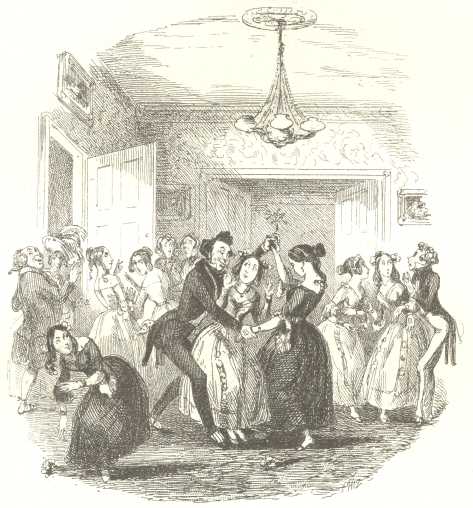
When the round game and several games at blind man’sbuff which followed it were all over, and we were going down tosupper, the inexhaustible Mr. Griggins produced a small sprig ofmistletoe from his waistcoat pocket, and commenced a generalkissing of the assembled females, which occasioned greatcommotion and much excitement. We observed that severalyoung gentlemen—including the young gentleman with the palecountenance—were greatly scandalised at this indecorousproceeding, and talked very big among themselves in corners; andwe observed too, that several young ladies when remonstrated withby the aforesaid young gentlemen, called each other to witnesshow they had struggled, and protested vehemently that it was veryrude, and that they were surprised at Mrs. Brown’s allowingit, and that they couldn’t bear it, and had no patiencewith such impertinence. But such is the gentle andforgiving nature of woman, that although we looked very narrowlyfor it, we could not detect the slightest harshness in thesubsequent treatment of Mr. Griggins. Indeed, upon thewhole, it struck us that among the ladies he seemed rather morepopular than before!
To recount all the drollery of Mr. Griggins at supper, wouldfill such a tiny volume as this, [429] to the very bottomof the outside cover. How he drank out of otherpeople’s glasses, and ate of other people’s bread,how he frightened into screaming convulsions a little boy who wassitting up to supper in a high chair, by sinking below the tableand suddenly reappearing with a mask on; how the hostess wasreally surprised that anybody could find a pleasure in tormentingchildren, and how the host frowned at the hostess, and feltconvinced that Mr. Griggins had done it with the very bestintentions; how Mr. Griggins explained, and how everybody’sgood-humour was restored but the child’s;—to tellthese and a hundred other things ever so briefly, would occupymore of our room and our readers’ patience, than eitherthey or we can conveniently spare. Therefore we change thesubject, merely observing that we have offered no description ofthe funny young gentleman’s personal appearance, believingthat almost every society has a Griggins of its own, and leavingall readers to supply the deficiency, according to the particularcircumstances of their particular case.
p. 431THETHEATRICAL YOUNG GENTLEMAN
All gentlemen who love thedrama—and there are few gentlemen who are not attached tothe most intellectual and rational of all our amusements—donot come within this definition. As we have no mean relishfor theatrical entertainments ourself, we are disinterestedlyanxious that this should be perfectly understood.
The theatrical young gentleman has early and importantinformation on all theatrical topics. ‘Well,’says he, abruptly, when you meet him in the street,‘here’s a pretty to-do. Flimkins has thrown uphis part in the melodrama at the Surrey.’—‘Andwhat’s to be done?’ you inquire with as much gravityas you can counterfeit. ‘Ah, that’s thepoint,’ replies the theatrical young gentleman, lookingvery serious; ‘Boozle declines it; positively declinesit. From all I am told, I should say it was decidedly inBoozle’s line, and that he would be very likely to make agreat hit in it; but he objects on the ground of Flimkins havingbeen put up in the part first, and says no earthly power shallinduce him to take the character. It’s a fine part,too—excellent business, I’m told. He has tokill six people in the course of the piece, and to fight over abridge in red fire, which is as safe a card, you know, as canbe. Don’t mention it; but I hear that the last scene,when he is first poisoned, and then stabbed, by Mrs. Flimkins asVengedora, will be the greatest thing that has been done thesemany years.’ With this piece of news, and laying hisfinger on his lips as a caution for you not to excite the townwith it, the theatrical young gentleman hurries away.
The theatrical young gentleman, from often frequenting thedifferent theatrical establishments, has pet and familiar namesfor them all. Thus Covent-Garden is the garden, Drury-Lanethe lane, the Victoria the vic, and the Olympic the pic. Actresses, too, are always designated by their surnames only, asTaylor, Nisbett, Faucit, Honey; that talented and lady-like girlSheriff, that clever little creature Horton, and so on. Inthe same manner he prefixes Christian names when he mentionsactors, as Charley Young, Jemmy Buckstone, Fred. Yates, PaulBedford. When he is at a loss for a Christian name, theword ‘old’ applied indiscriminately answers quite aswell: as old Charley Matthews at Vestris’s, old Harley, andold Braham. He has a great knowledge of the privateproceedings of actresses, especially of their getting married,and can tell you in a breath half-a-dozen who have changed theirnames without avowing it. Whenever an alteration of thiskind is made in the playbills, he will remind you that he let youinto the secret six months ago.
The theatrical young gentleman has a great reverence for allthat is connected with the stage department of the differenttheatres. He would, at any time, prefer going a street ortwo out of his way, to omitting to pass a stage-entrance, intowhich he always looks with a curious and searching eye. Ifhe can only identify a popular actor in the street, he is in aperfect transport of delight; and no sooner meets him, than hehurries back, and walks a few paces in front of him, so that hecan turn round from time to time, and have a good stare at hisfeatures. He looks upon a theatrical-fund dinner as one ofthe most enchanting festivities ever known; and thinks that to bea member of the Garrick Club, and see so many actors in theirplain clothes, must be one of the highest gratifications theworld can bestow.
The theatrical young gentleman is a constant half-pricevisitor at one or other of the theatres, and has an infiniterelish for all pieces which display the fullest resources of theestablishment. He likes to place implicit reliance upon theplay-bills when he goes to see a show-piece, and works himself upto such a pitch of enthusiasm, as not only to believe (if thebills say so) that there are three hundred and seventy-fivepeople on the stage at one time in the last scene, but is highlyindignant with you, unless you believe it also. Heconsiders that if the stage be opened from the foot-lights to theback wall, in any new play, the piece is a triumph of dramaticwriting, and applauds accordingly. He has a great notion oftrap-doors too; and thinks any character going down or coming upa trap (no matter whether he be an angel or a demon—theyboth do it occasionally) one of the most interesting feats in thewhole range of scenic illusion.
Besides these acquirements, he has several veracious accountsto communicate of the private manners and customs of differentactors, which, during the pauses of a quadrille, he usuallycommunicates to his partner, or imparts to his neighbour at asupper table. Thus he is advised, that Mr. Liston alwayshad a footman in gorgeous livery waiting at the side-scene with abrandy bottle and tumbler, to administer half a pint or so ofspirit to him every time he came off, without which assistance hemust infallibly have fainted. He knows for a fact, that,after an arduous part, Mr. George Bennett is put between twofeather beds, to absorb the perspiration; and is crediblyinformed, that Mr. Baker has, for many years, submitted to acourse of lukewarm toast-and-water, to qualify him to sustain hisfavourite characters. He looks upon Mr. Fitz Ball as theprincipal dramatic genius and poet of the day; but holds thatthere are great writers extant besides him,—in proofwhereof he refers you to various dramas and melodramas recentlyproduced, of which he takes in all the sixpenny and three-pennyeditions as fast as they appear.
The theatrical young gentleman is a great advocate forviolence of emotion and redundancy of action. If a fatherhas to curse a child upon the stage, he likes to see it done inthe thorough-going style, with no mistake about it: to which endit is essential that the child should follow the father on herknees, and be knocked violently over on her face by the oldgentleman as he goes into a small cottage, and shuts the doorbehind him. He likes to see a blessing invoked upon theyoung lady, when the old gentleman repents, with equalearnestness, and accompanied by the usual conventional forms,which consist of the old gentleman looking anxiously up into theclouds, as if to see whether it rains, and then spreading animaginary tablecloth in the air over the young lady’shead—soft music playing all the while. Upon these,and other points of a similar kind, the theatrical younggentleman is a great critic indeed. He is likewise veryacute in judging of natural expressions of the passions, andknows precisely the frown, wink, nod, or leer, which stands forany one of them, or the means by which it may be converted intoany other: as jealousy, with a good stamp of the right foot,becomes anger; or wildness, with the hands clasped before thethroat, instead of tearing the wig, is passionate love. Ifyou venture to express a doubt of the accuracy of any of theseportraitures, the theatrical young gentleman assures you, with ahaughty smile, that it always has been done in that way, and hesupposes they are not going to change it at this time of day toplease you; to which, of course, you meekly reply that yousuppose not.
There are innumerable disquisitions of this nature, in whichthe theatrical young gentleman is very profound, especially toladies whom he is most in the habit of entertaining with them;but as we have no space to recapitulate them at greater length,we must rest content with calling the attention of the youngladies in general to the theatrical young gentlemen of their ownacquaintance.
p. 433THEPOETICAL YOUNG GENTLEMAN
Time was, and not very long agoeither, when a singular epidemic raged among the young gentlemen,vast numbers of whom, under the influence of the malady, tore offtheir neckerchiefs, turned down their shirt collars, andexhibited themselves in the open streets with bare throats anddejected countenances, before the eyes of an astonishedpublic. These were poetical young gentlemen. Thecustom was gradually found to be inconvenient, as involving thenecessity of too much clean linen and too large washing bills,and these outward symptoms have consequently passed away; but weare disposed to think, notwithstanding, that the number ofpoetical young gentlemen is considerably on the increase.
We know a poetical young gentleman—a very poetical younggentleman. We do not mean to say that he is troubled withthe gift of poesy in any remarkable degree, but his countenanceis of a plaintive and melancholy cast, his manner is abstractedand bespeaks affliction of soul: he seldom has his hair cut, andoften talks about being an outcast and wanting a kindred spirit;from which, as well as from many general observations in which heis wont to indulge, concerning mysterious impulses, and yearningsof the heart, and the supremacy of intellect gilding all earthlythings with the glowing magic of immortal verse, it is clear toall his friends that he has been stricken poetical.
The favourite attitude of the poetical young gentleman islounging on a sofa with his eyes fixed upon the ceiling, orsitting bolt upright in a high-backed chair, staring with veryround eyes at the opposite wall. When he is in one of thesepositions, his mother, who is a worthy, affectionate old soul,will give you a nudge to bespeak your attention withoutdisturbing the abstracted one, and whisper with a shake of thehead, that John’s imagination is at some extraordinary workor other, you may take her word for it. Hereupon John looksmore fiercely intent upon vacancy than before, and suddenlysnatching a pencil from his pocket, puts down three words, and across on the back of a card, sighs deeply, paces once or twiceacross the room, inflicts a most unmerciful slap upon his head,and walks moodily up to his dormitory.
The poetical young gentleman is apt to acquire peculiarnotions of things too, which plain ordinary people, unblessedwith a poetical obliquity of vision, would suppose to be ratherdistorted. For instance, when the sickening murder andmangling of a wretched woman was affording delicious foodwherewithal to gorge the insatiable curiosity of the public, ourfriend the poetical young gentleman was in ecstasies—not ofdisgust, but admiration. ‘Heavens!’ cried thepoetical young gentleman, ‘how grand; howgreat!’ We ventured deferentially to inquire uponwhom these epithets were bestowed: our humble thoughtsoscillating between the police officer who found the criminal,and the lock-keeper who found the head. ‘Uponwhom!’ exclaimed the poetical young gentleman in a frenzyof poetry, ‘Upon whom should they be bestowed but upon themurderer!’—and thereupon it came out, in a finetorrent of eloquence, that the murderer was a great spirit, abold creature full of daring and nerve, a man of dauntless heartand determined courage, and withal a great casuist and ablereasoner, as was fully demonstrated in his philosophicalcolloquies with the great and noble of the land. We heldour peace, and meekly signified our indisposition to controvertthese opinions—firstly, because we were no match atquotation for the poetical young gentleman; and secondly, becausewe felt it would be of little use our entering into anydisputation, if we were: being perfectly convinced that therespectable and immoral hero in question is not the first andwill not be the last hanged gentleman upon whom false sympathy ordiseased curiosity will be plentifully expended.
This was a stern mystic flight of the poetical younggentleman. In his milder and softer moments he occasionallylays down his neckcloth, and pens stanzas, which sometimes findtheir way into a Lady’s Magazine, or the‘Poets’ Corner’ of some country newspaper; orwhich, in default of either vent for his genius, adorn therainbow leaves of a lady’s album. These are generallywritten upon some such occasions as contemplating the Bank ofEngland by midnight, or beholding Saint Paul’s in asnow-storm; and when these gloomy objects fail to afford himinspiration, he pours forth his soul in a touching address to aviolet, or a plaintive lament that he is no longer a child, buthas gradually grown up.
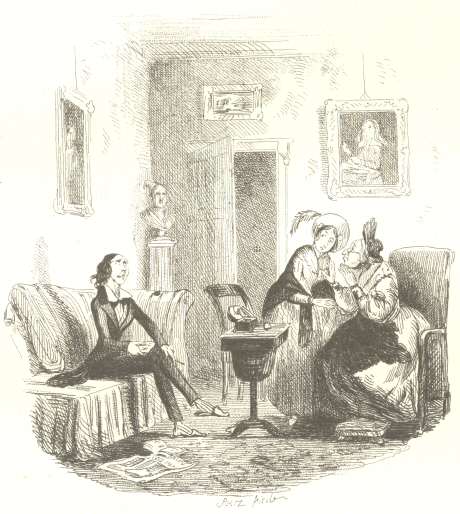
The poetical young gentleman is fond of quoting passages fromhis favourite authors, who are all of the gloomy and despondingschool. He has a great deal to say too about the world, andis much given to opining, especially if he has taken anythingstrong to drink, that there is nothing in it worth livingfor. He gives you to understand, however, that for the sakeof society, he means to bear his part in the tiresome play,manfully resisting the gratification of his own strong desire tomake a premature exit; and consoles himself with the reflection,that immortality has some chosen nook for himself and the othergreat spirits whom earth has chafed and wearied.
When the poetical young gentleman makes use of adjectives,they are all superlatives. Everything is of the grandest,greatest, noblest, mightiest, loftiest; or the lowest, meanest,obscurest, vilest, and most pitiful. He knows no medium:for enthusiasm is the soul of poetry; and who so enthusiastic asa poetical young gentleman? ‘Mr. Milkwash,’says a young lady as she unlocks her album to receive the younggentleman’s original impromptu contribution, ‘howvery silent you are! I think you must be inlove.’ ‘Love!’ cries the poetical younggentleman, starting from his seat by the fire and terrifying thecat who scampers off at full speed, ‘Love! that burning,consuming passion; that ardour of the soul, that fierce glowingof the heart. Love! The withering, blightinginfluence of hope misplaced and affection slighted. Lovedid you say! Ha! ha! ha!’
With this, the poetical young gentleman laughs a laughbelonging only to poets and Mr. O. Smith of the Adelphi Theatre,and sits down, pen in hand, to throw off a page or two of versein the biting, semi-atheistical demoniac style, which, like thepoetical young gentleman himself, is full of sound and fury,signifying nothing.
p. 436THE‘THROWING-OFF’ YOUNG GENTLEMAN
There is a certain kind ofimpostor—a bragging, vaunting, puffing younggentleman—against whom we are desirous to warn that fairerpart of the creation, to whom we more peculiarly devote these ourlabours. And we are particularly induced to lay especialstress upon this division of our subject, by a little dialogue weheld some short time ago, with an esteemed young lady of ouracquaintance, touching a most gross specimen of this class ofmen. We had been urging all the absurdities of his conductand conversation, and dwelling upon the impossibilities heconstantly recounted—to which indeed we had not scrupled toprefix a certain hard little word of one syllable and threeletters—when our fair friend, unable to maintain thecontest any longer, reluctantly cried, ‘Well; he certainlyhas a habit of throwing-off, but then—’ Whatthen? Throw him off yourself, said we. And so shedid, but not at our instance, for other reasons appeared, and itmight have been better if she had done so at first.
The throwing-off young gentleman has so often a fatherpossessed of vast property in some remote district of Ireland,that we look with some suspicion upon all young gentlemen whovolunteer this description of themselves. The deceasedgrandfather of the throwing-off young gentleman was a man ofimmense possessions, and untold wealth; the throwing-off younggentleman remembers, as well as if it were only yesterday, thedeceased baronet’s library, with its long rows of scarceand valuable books in superbly embossed bindings, arranged incases, reaching from the lofty ceiling to the oaken floor; andthe fine antique chairs and tables, and the noble old castle ofBallykillbabaloo, with its splendid prospect of hill and dale,and wood, and rich wild scenery, and the fine hunting stables andthe spacious court-yards, ‘and—and—everythingupon the same magnificent scale,’ says the throwing-offyoung gentleman, ‘princely; quite princely. Ah!’ And he sighs as if mourning over the fallenfortunes of his noble house.
The throwing-off young gentleman is a universal genius; atwalking, running, rowing, swimming, and skating, he isunrivalled; at all games of chance or skill, at hunting,shooting, fishing, riding, driving, or amateur theatricals, noone can touch him—that is couldnot, because hegives you carefully to understand, lest there should be anyopportunity of testing his skill, that he is quite out ofpractice just now, and has been for some years. If youmention any beautiful girl of your common acquaintance in hishearing, the throwing-off young gentleman starts, smiles, andbegs you not to mind him, for it was quite involuntary: people dosay indeed that they were once engaged, but no—although sheis a very fine girl, he was so situated at that time that hecouldn’t possibly encourage the—‘but it’sof no use talking about it!’ he adds, interruptinghimself. ‘She has got over it now, and I firmly hopeand trust is happy.’ With this benevolent aspirationhe nods his head in a mysterious manner, and whistling the firstpart of some popular air, thinks perhaps it will be better tochange the subject.
There is another great characteristic of the throwing-offyoung gentleman, which is, that he ‘happens to beacquainted’ with a most extraordinary variety of people inall parts of the world. Thus in all disputed questions,when the throwing-off young gentleman has no argument to bringforward, he invariably happens to be acquainted with some distantperson, intimately connected with the subject, whose testimonydecides the point against you, to the great—may we sayit—to the great admiration of three young ladies out ofevery four, who consider the throwing-off young gentleman a veryhighly-connected young man, and a most charming person.
Sometimes the throwing-off young gentleman happens to look inupon a little family circle of young ladies who are quietlyspending the evening together, and then indeed is he at the veryheight and summit of his glory; for it is to be observed that heby no means shines to equal advantage in the presence of men asin the society of over-credulous young ladies, which is hisproper element. It is delightful to hear the number ofpretty things the throwing-off young gentleman gives utteranceto, during tea, and still more so to observe the ease with which,from long practice and study, he delicately blends one complimentto a lady with two for himself. ‘Did you ever see amore lovely blue than this flower, Mr. Caveton?’ asks ayoung lady who, truth to tell, is rather smitten with thethrowing-off young gentleman. ‘Never,’ hereplies, bending over the object of admiration, ‘never butin your eyes.’ ‘Oh, Mr. Caveton,’ criesthe young lady, blushing of course. ‘Indeed I speakthe truth,’ replies the throwing-off young gentleman,‘I never saw any approach to them. I used to think mycousin’s blue eyes lovely, but they grow dim and colourlessbeside yours.’ ‘Oh! a beautiful cousin, Mr.Caveton!’ replies the young lady, with that perfectartlessness which is the distinguishing characteristic of allyoung ladies; ‘an affair, of course.’ ‘No; indeed, indeed you wrong me,’ rejoins thethrowing-off young gentleman with great energy. ‘Ifervently hope that her attachment towards me may be nothing butthe natural result of our close intimacy in childhood, and thatin change of scene and among new faces she may soon overcomeit. Ilove her! Think not so meanly of me,Miss Lowfield, I beseech, as to suppose that title, lands,riches, and beauty, can influence mychoice. Theheart, the heart, Miss Lowfield.’ Here thethrowing-off young gentleman sinks his voice to a still lowerwhisper; and the young lady duly proclaims to all the other youngladies when they go up-stairs, to put their bonnets on, that Mr.Caveton’s relations are all immensely rich, and that he ishopelessly beloved by title, lands, riches, and beauty.
We have seen a throwing-off young gentleman who, to ourcertain knowledge, was innocent of a note of music, and scarcelyable to recognise a tune by ear, volunteer a Spanish air upon theguitar when he had previously satisfied himself that there wasnot such an instrument within a mile of the house.
We have heard another throwing-off young gentleman, afterstriking a note or two upon the piano, and accompanying itcorrectly (by dint of laborious practice) with his voice, assurea circle of wondering listeners that so acute was his ear that hewas wholly unable to sing out of tune, let him try as hewould. We have lived to witness the unmasking of anotherthrowing-off young gentleman, who went out a visiting in amilitary cap with a gold band and tassel, and who, after passingsuccessfully for a captain and being lauded to the skies for hisred whiskers, his bravery, his soldierly bearing and his pride,turned out to be the dishonest son of an honest linen-draper in asmall country town, and whom, if it were not for this fortunateexposure, we should not yet despair of encountering as thefortunate husband of some rich heiress. Ladies, ladies, thethrowing-off young gentlemen are often swindlers, and alwaysfools. So pray you avoid them.
p. 439THEYOUNG LADIES’ YOUNG GENTLEMAN
This young gentleman has severaltitles. Some young ladies consider him ‘a nice youngman,’ others ‘a fine young man,’ others‘quite a lady’s man,’ others ‘a handsomeman,’ others ‘a remarkably good-looking youngman.’ With some young ladies he is ‘a perfectangel,’ and with others ‘quite a love.’ He is likewise a charming creature, a duck, and a dear.
The young ladies’ young gentleman has usually a freshcolour and very white teeth, which latter articles, of course, hedisplays on every possible opportunity. He has brown orblack hair, and whiskers of the same, if possible; but a slighttinge of red, or the hue which is vulgarly known as sandy,is not considered an objection. If his head and face belarge, his nose prominent, and his figure square, he is anuncommonly fine young man, and worshipped accordingly. Should his whiskers meet beneath his chin, so much the better,though this is not absolutely insisted on; but he must wear anunder-waistcoat, and smile constantly.
There was a great party got up by some party-loving friends ofours last summer, to go and dine in Epping Forest. As wehold that such wild expeditions should never be indulged in, saveby people of the smallest means, who have no dinner at home, weshould indubitably have excused ourself from attending, if we hadnot recollected that the projectors of the excursion were alwaysaccompanied on such occasions by a choice sample of the youngladies’ young gentleman, whom we were very anxious to havean opportunity of meeting. This determined us, and wewent.
We were to make for Chigwell in four glass coaches, each witha trifling company of six or eight inside, and a little boybelonging to the projectors on the box—and to start fromthe residence of the projectors, Woburn-place, Russell-square, athalf-past ten precisely. We arrived at the place ofrendezvous at the appointed time, and found the glass coaches andthe little boys quite ready, and divers young ladies and younggentlemen looking anxiously over the breakfast-parlour blinds,who appeared by no means so much gratified by our approach as wemight have expected, but evidently wished we had been somebodyelse. Observing that our arrival in lieu of the unknownoccasioned some disappointment, we ventured to inquire who wasyet to come, when we found from the hasty reply of a dozenvoices, that it was no other than the young ladies’ younggentleman.
‘I cannot imagine,’ said the mamma, ‘whathas become of Mr. Balim—always so punctual, always sopleasant and agreeable. I am sure I can-notthink.’ As these last words were uttered in thatmeasured, emphatic manner which painfully announces that thespeaker has not quite made up his or her mind what to say, but isdetermined to talk on nevertheless, the eldest daughter took upthe subject, and hoped no accident had happened to Mr. Balim,upon which there was a general chorus of ‘Dear Mr.Balim!’ and one young lady, more adventurous than the rest,proposed that an express should be straightway sent to dear Mr.Balim’s lodgings. This, however, the papa resolutelyopposed, observing, in what a short young lady behind us termed‘quite a bearish way,’ that if Mr. Balim didn’tchoose to come, he might stop at home. At this all thedaughters raised a murmur of ‘Oh pa!’ except onesprightly little girl of eight or ten years old, who, takingadvantage of a pause in the discourse, remarked, that perhaps Mr.Balim might have been married that morning—for whichimpertinent suggestion she was summarily ejected from the room byher eldest sister.
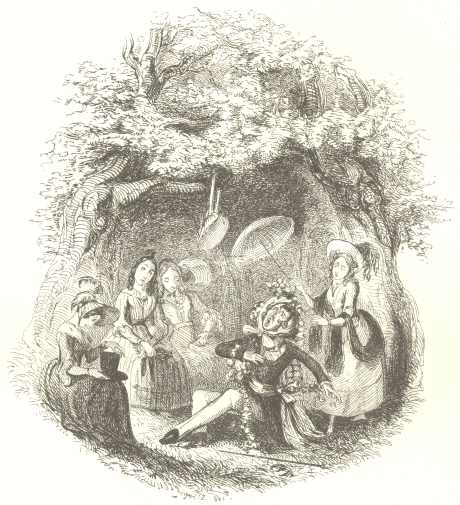
We were all in a state of great mortification and uneasiness,when one of the little boys, running into the room as airily aslittle boys usually run who have an unlimited allowance of animalfood in the holidays, and keep their hands constantly forced downto the bottoms of very deep trouser-pockets when they takeexercise, joyfully announced that Mr. Balim was at that momentcoming up the street in a hackney-cab; and the intelligence wasconfirmed beyond all doubt a minute afterwards by the entry ofMr. Balim himself, who was received with repeated cries of‘Where have you been, you naughty creature?’whereunto the naughty creature replied, that he had been in bed,in consequence of a late party the night before, and had onlyjust risen. The acknowledgment awakened a variety ofagonizing fears that he had taken no breakfast; which appearingafter a slight cross-examination to be the real state of thecase, breakfast for one was immediately ordered, notwithstandingMr. Balim’s repeated protestations that he couldn’tthink of it. He did think of it though, and thought betterof it too, for he made a remarkably good meal when it came, andwas assiduously served by a select knot of young ladies. Itwas quite delightful to see how he ate and drank, while one pairof fair hands poured out his coffee, and another put in thesugar, and another the milk; the rest of the company ever andanon casting angry glances at their watches, and the glasscoaches,—and the little boys looking on in an agony ofapprehension lest it should begin to rain before we set out; itmight have rained all day, after we were once too far to turnback again, and welcome, for aught they cared.
However, the cavalcade moved at length, every coachman beingaccommodated with a hamper between his legs something larger thana wheelbarrow; and the company being packed as closely as theypossibly could in the carriages, ‘according,’ as onemarried lady observed, ‘to the immemorial custom, which washalf the diversion of gipsy parties.’ Thinking itvery likely it might be (we have never been able to discover theother half), we submitted to be stowed away with a cheerfulaspect, and were fortunate enough to occupy one corner of a coachin which were one old lady, four young ladies, and the renownedMr. Balim the young ladies’ young gentleman.
We were no sooner fairly off, than the young ladies’young gentleman hummed a fragment of an air, which induced ayoung lady to inquire whether he had danced to that the nightbefore. ‘By Heaven, then, I did,’ replied theyoung gentleman, ‘and with a lovely heiress; a superbcreature, with twenty thousand pounds.’ ‘Youseem rather struck,’ observed another young lady. ‘’Gad she was a sweet creature,’ returned theyoung gentleman, arranging his hair. ‘Of courseshewas struck too?’ inquired the first younglady. ‘How can you ask, love?’ interposed thesecond; ‘could she fail to be?’ ‘Well,honestly I think she was,’ observed the younggentleman. At this point of the dialogue, the young ladywho had spoken first, and who sat on the young gentleman’sright, struck him a severe blow on the arm with a rosebud, andsaid he was a vain man—whereupon the young gentlemaninsisted on having the rosebud, and the young lady appealing forhelp to the other young ladies, a charming struggle ensued,terminating in the victory of the young gentleman, and thecapture of the rosebud. This little skirmish over, themarried lady, who was the mother of the rosebud, smiled sweetlyupon the young gentleman, and accused him of being a flirt; theyoung gentleman pleading not guilty, a most interestingdiscussion took place upon the important point whether the younggentleman was a flirt or not, which being an agreeableconversation of a light kind, lasted a considerable time. At length, a short silence occurring, the young ladies on eitherside of the young gentleman fell suddenly fast asleep; and theyoung gentleman, winking upon us to preserve silence, won a pairof gloves from each, thereby causing them to wake with equalsuddenness and to scream very loud. The lively conversationto which this pleasantry gave rise, lasted for the remainder ofthe ride, and would have eked out a much longer one.
We dined rather more comfortably than people usually do undersuch circumstances, nothing having been left behind but thecork-screw and the bread. The married gentlemen wereunusually thirsty, which they attributed to the heat of theweather; the little boys ate to inconvenience; mammas were veryjovial, and their daughters very fascinating; and the attendantsbeing well-behaved men, got exceedingly drunk at a respectfuldistance.
We had our eye on Mr. Balim at dinner-time, and perceived thathe flourished wonderfully, being still surrounded by a littlegroup of young ladies, who listened to him as an oracle, while heate from their plates and drank from their glasses in a mannertruly captivating from its excessive playfulness. Hisconversation, too, was exceedingly brilliant. In fact, oneelderly lady assured us, that in the course of a little livelybadinageon the subject of ladies’ dresses, he hadevinced as much knowledge as if he had been born and bred amilliner.
As such of the fat people who did not happen to fall asleepafter dinner entered upon a most vigorous game at ball, weslipped away alone into a thicker part of the wood, hoping tofall in with Mr. Balim, the greater part of the young peoplehaving dropped off in twos and threes and the young ladies’young gentleman among them. Nor were we disappointed, forwe had not walked far, when, peeping through the trees, wediscovered him before us, and truly it was a pleasant thing tocontemplate his greatness.
The young ladies’ young gentleman was seated upon theground, at the feet of a few young ladies who were reclining on abank; he was so profusely decked with scarfs, ribands, flowers,and other pretty spoils, that he looked like a lamb—orperhaps a calf would be a better simile—adorned for thesacrifice. One young lady supported a parasol over hisinteresting head, another held his hat, and a third hisneck-cloth, which in romantic fashion he had thrown off; theyoung gentleman himself, with his hand upon his breast, and hisface moulded into an expression of the most honeyed sweetness,was warbling forth some choice specimens of vocal music in praiseof female loveliness, in a style so exquisitely perfect, that weburst into an involuntary shout of laughter, and made a hastyretreat.
What charming fellows these young ladies’ younggentlemen are! Ducks, dears, loves, angels, are all termsinadequate to express their merit. They are such amazingly,uncommonly, wonderfully, nice men.
p.443CONCLUSION
As we have placed before the youngladies so many specimens of young gentlemen, and have also in thededication of this volume given them to understand how much wereverence and admire their numerous virtues and perfections; aswe have given them such strong reasons to treat us withconfidence, and to banish, in our case, all that reserve anddistrust of the male sex which, as a point of general behaviour,they cannot do better than preserve and maintain—we say, aswe have done all this, we feel that now, when we have arrived atthe close of our task, they may naturally press upon us theinquiry, what particular description of young gentlemen we canconscientiously recommend.
Here we are at a loss. We look over our list, and canneither recommend the bashful young gentleman, nor theout-and-out young gentleman, nor the very friendly younggentleman, nor the military young gentleman, nor the politicalyoung gentleman, nor the domestic young gentleman, nor thecensorious young gentleman, nor the funny young gentleman, northe theatrical young gentleman, nor the poetical young gentleman,nor the throwing-off young gentleman, nor the young ladies’young gentleman.
As there are some good points about many of them, which stillare not sufficiently numerous to render any one among themeligible, as a whole, our respectful advice to the young ladiesis, to seek for a young gentleman who unites in himself the bestqualities of all, and the worst weaknesses of none, and to leadhim forthwith to the hymeneal altar, whether he will or no. And to the young lady who secures him, we beg to tender one shortfragment of matrimonial advice, selected from many sound passagesof a similar tendency, to be found in a letter written by DeanSwift to a young lady on her marriage.
‘The grand affair of your life will be, to gain andpreserve the esteem of your husband. Neither good-naturenor virtue will suffer him to esteemyou against hisjudgment; and although he is not capable of using you ill, yetyou will in time grow a thing indifferent and perhapscontemptible; unless you can supply the loss of youth and beautywith more durable qualities. You have but a very few yearsto be young and handsome in the eyes of the world; and as fewmonths to be so in the eyes of a husband who is not a fool; for Ihope you do not still dream of charms and raptures, whichmarriage ever did, and ever will, put a sudden end to.’
From the anxiety we express for the proper behaviour of thefortunate lady after marriage, it may possibly be inferred thatthe young gentleman to whom we have so delicately alluded, is noother than ourself. Without in any way committing ourselfupon this point, we have merely to observe, that we are ready toreceive sealed offers containing a full specification of age,temper, appearance, and condition; but we beg it to be distinctlyunderstood that we do not pledge ourself to accept the highestbidder.
These offers may be forwarded to the Publishers, Messrs.Chapman and Hall, London; to whom all pieces of plate and othertestimonials of approbation from the young ladies generally, arerespectfully requested to be addressed.
FOOTNOTES
[429] [In its original form.]
Article URL: http://40407.stemtoysfor10yearolds.shop/html/79c699914.html
Copyright notice
This article reflects the author's views only and does not represent this site.
Published with the author's permission. Do not reprint without approval.